
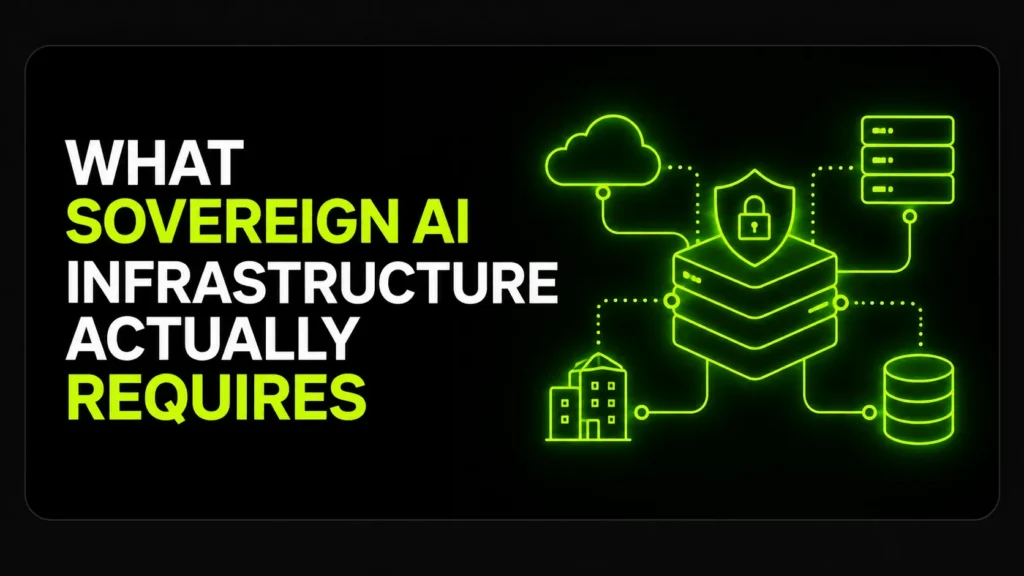
What Sovereign AI Infrastructure Actually Requires
Subtitle:
Why sovereign AI is not simply a matter of selecting a cloud region—and what infrastructure has to coordinate instead.
Artificial intelligence infrastructure is becoming more distributed.
Models may run in one environment, retrieval systems in another, enterprise data may remain inside customer-controlled infrastructure, and agent workflows may interact with systems that span multiple regions, providers, or organizational boundaries.
For many organizations, that is manageable.
For organizations operating sensitive, regulated, jurisdiction-aware, or high-value AI workloads, it creates a different infrastructure problem.
Sovereign AI infrastructure is not simply a matter of selecting a cloud region.
It requires an infrastructure architecture capable of coordinating where workloads operate, where data is processed, which environments may participate, and how activity is observed across the system.
Sovereignty Begins With Infrastructure Boundaries
Traditional cloud architecture is often organized around individual services: compute, storage, databases, networking, and applications.
AI workloads introduce additional infrastructure relationships.
- A private model may depend on GPU infrastructure.
- A retrieval pipeline may depend on vector storage and document-processing systems.
- An agent may depend on external tools, APIs, enterprise applications, and credentials.
Each of those components can create a different infrastructure path.
For sensitive workloads, the important question becomes:
Where is each part of the AI system actually operating?
That requires clearly defined boundaries around compute, retrieval, storage, runtime environments, and connected systems.
Region-Aligned Compute
Regional deployment is one of the foundations of sovereign AI infrastructure.
Organizations may need workloads to operate within specific geographic or jurisdictional environments because of regulatory obligations, contractual requirements, internal policy, or data-residency considerations.
Region-aligned infrastructure allows compute resources to be organized around those requirements.
But compute location alone is not enough.
The model may execute in one region while the vector store, context assembly, agent tool, or logging system operates somewhere else.
For regional controls to be meaningful, the broader workload path has to be considered.
Private Model Environments
Sensitive enterprise workloads often require greater control over how models are deployed and accessed.
Private model environments can reduce reliance on shared external AI services and provide organizations with more control over:
- infrastructure placement
- model access
- runtime configuration
- persistence behavior
- tenant boundaries
- integrations
The objective is not simply to “host a model privately.”
The objective is to make the model part of an infrastructure environment designed around the organization’s operational requirements.
Retrieval Infrastructure Is Part of the Sovereignty Boundary
Retrieval-augmented generation introduces another layer.
Documents may be transformed into embeddings.
Embeddings may be stored in vector infrastructure.
Queries may retrieve information from indexes.
Retrieved context may then be assembled and passed to a model.
If these systems are deployed independently, data can cross infrastructure boundaries even when the model itself is region-aligned.
Sovereign AI infrastructure therefore has to consider retrieval as part of the same infrastructure problem.
Vector stores, retrieval paths, context assembly, and model execution should be designed around compatible regional and tenant requirements.
Agents Expand the Infrastructure Surface
AI agents introduce an even broader set of dependencies.
An agent may interact with:
- enterprise applications
- databases
- APIs
- internal tools
- external services
- credentials
- other agents
This means an agent is not merely a model workload.
It is an infrastructure participant capable of interacting with multiple systems.
Organizations therefore need visibility into the environment in which the agent operates, the systems it can reach, and the infrastructure boundaries associated with those actions.
Sovereignty Also Requires Observability
Infrastructure controls are difficult to manage without visibility.
Organizations need operational information about where workloads ran, which infrastructure environments participated, how requests were routed, and which systems were involved.
This does not necessarily require storing customer content.
Operational observability can be built around non-content metadata such as workload identifiers, region information, deployment events, routing events, and infrastructure state.
That gives organizations a clearer view of how AI infrastructure is behaving without making application content the center of the operational audit stream.
Hosted Infrastructure Is Only One Model
Some organizations want a managed infrastructure environment.
Others already operate private cloud, VPC, on-premises, or specialized infrastructure that they do not want to replace.
For that reason, sovereign AI infrastructure increasingly needs to support more than one deployment model.
A practical architecture may include:
- hosted infrastructure
- connected customer-controlled infrastructure
- on-premises environments
- private cloud environments
- hybrid combinations of these systems
The goal is not necessarily to move everything into one provider environment.
The goal is to coordinate AI infrastructure across the environments that an organization actually uses.
Sovereign AI Is an Infrastructure Architecture
The distinction matters.
Sovereign AI infrastructure is not simply:
- a private GPU
- a cloud region
- a dedicated model endpoint
- a vector database in a selected jurisdiction
Those may all be components.
The broader requirement is an infrastructure architecture capable of coordinating compute, model environments, retrieval systems, agents, regional requirements, tenant boundaries, and operational visibility.
That is the level at which sovereignty becomes an infrastructure property rather than a deployment label.
Attababy is designed around this infrastructure problem.
Its platform supports region-aligned compute, private model environments, vector and retrieval infrastructure, agent workloads, connected customer-controlled infrastructure, and operational visibility across hosted, connected, and hybrid deployments.